logo Virtual CommissioningTM (VCxTM) is an innovative energy efficiency program which provides utilities with a mass market small and medium business (SMB) solution by capitalizing on AMI investment. Want to learn more?
Feel Free To Contact Us
We’d be happy to hear from you and answer any of your questions about Power TakeOff services.


1-800-303-9890

support@powertakeoff.com

sales@powertakeoff.com

Top

Can You Use Linear Regression for Equipment-Level M&V?

Many M&V professionals are seeing a shift away from IPMVP Option C, which uses a linear regression model with whole-facility consumption data to model energy savings. This is due to a few reasons: 

  1. Cost,
  2. It is difficult to gather consumption data from clients, and
  3. Changes in industry standards and federal guidelines have become more accepting of equipment level savings approaches.

However, there is also a shift in supporting measured vs. deemed savings. Equipment level savings can be deemed with simple engineering calculations and assumed variables, but this can leave valuable savings on the table. The DOE and BPA have both published methods for a measured savings approach for individual pieces of equipment in which a linear regression can be used. 

Are there different ways to measure equipment level savings?

Measuring savings for an individual piece of equipment can be done with simple engineering calculations or a linear regression model. When isolating the key parameter (known as IPMVP Option A), a linear regression approach cannot be used because the consumption is typically gathered from a spot measurement and the variables are stipulated. This option is utilized when full-time metering is unnecessary and is most often used for lighting retrofits.

When you are measuring multiple parameters (i.e., consumption, weather, occupancy), a linear regression works great. This is known as IPMVP Option B and factors in independent variables that affect the equipment’s energy consumption in its savings calculation. The consumption data is sourced from sub-meters or Building Management Systems (BMS) and is used when operating conditions or loads fluctuate

What type of equipment does a linear regression work well with?

A linear regression works best for HVAC loads, lighting controls, and VFDs. This method is best suited when:

  • You want to isolate savings to a single piece of equipment
  • The facility has interval BMS or sub-metered data
  • Simple engineering estimates cannot capture interactive effects

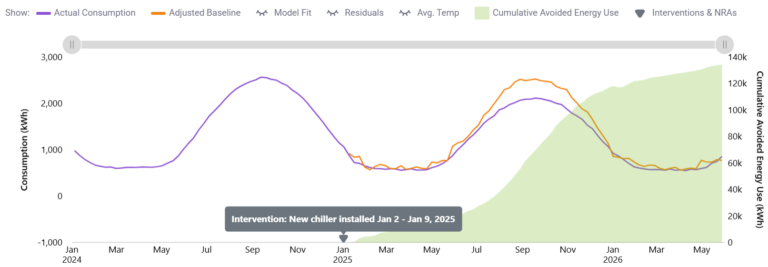
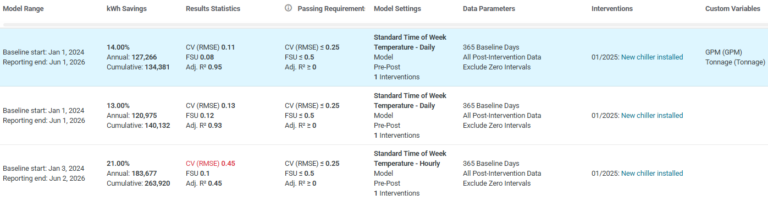
In the example below, we show how a chiller retrofit utilized a linear regression model to prove energy savings. A 12-month baseline period was used, as the building was equipped with a robust BMS system. The BMS system also logged Gallons Per Minute (GPM) and Tonnage per 15-minute interval. This chiller retrofit was commissioned in a commercial office building, so a daily time-of-week and temperature model was used, as the building’s occupancy was predictable and affected consumption. 

A normalized weather dataset was used to show annual savings for a typical year in this climate zone. You can see in the first model run that temperature and a time-of-week variable were the only independent variables used. Once GPM and tonnage were included as additional variables, the M&V model significantly improved.